Soutine Chaim Carcass of Beef Print Ebay
The Jewish Museum
May 4-September 16, 2018
The Jewish Museum presents an exhibition of 31 paintings by Chaim Soutine (1893-1943), the Expressionist artist known for his gestural and densely painted canvases, from May iv through September 16, 2018. Chaim Soutine: Flesh highlights the unique visual conceptions and painterly energy that the artist brought to the tradition of however life. Soutine's remarkable paintings depicting hanging fowl, beef carcasses, and rayfish are now considered amidst his greatest artistic achievements. These works epitomize his fusion of One-time Master influences with the tenets of painterly modernism. Virtuoso technique, expressive colour, and disorienting and unexpected compositions endow Soutine's depictions of slaughtered animals with a striking visual power and emotional bear on.

Chaim Soutine, Still Life with Rayfish, c. 1924, oil on canvas. Metropolitan Museum of Art, The Mr. and Mrs. Klaus G. Perls Drove, 1997 (1997.149.1)
Credit: Artwork © Artists Rights Society (ARS), New York; Image provided past The Metropolitan Museum of Art / Art Resource, NY
Chaim Soutine: Mankind presents works from the artist's early years in Paris through the 1940s, showing his development from more traditional conceptions to the impressive achievement of his paintings from the mid-1920s. Pushing the limits of the tradition of however life, in tableaux evocative of tearing dislocations, these paintings offer a tour de force of visual expression and visceral upshot.
Soutine's highly personal approach to the discipline of nevertheless life and the depictions of hanging fowl and beef carcasses were influenced by his babyhood memories growing up in a Jewish village in the Lithuanian office of western Russia (now Belarus). The strict Jewish observance of dietary laws, requiring the ritual slaughter of fowl and meat, provides a context for these emotionally charged images.
In 1913, at the age of 20, Soutine moved to Paris. He painted landscapes at various locations in French republic and created an of import body of work in portraiture. Soutine's study of Old Master paintings in the Louvre impacted his dramatic and novel compositions of a single object isolated in infinite.

Rembrandt'southward famous painting, The Flayed Ox (1655), and the still lifes of Goya, Chardin, and Courbet were of particular importance to Soutine.
Soutine painted directly from life. He would bring expressionless fowl and rabbits, and carcasses of beef, into his studio to employ equally subjects for his paintings. These subjects began to occupy the entire canvas, allowing the creative person to appoint with the images as a painted surface. Soutine'due south haunting imagery, energized brushstrokes, and rich pigment have served as touchstones for subsequent generations of artists, from Francis Bacon, Willem de Kooning, and Jackson Pollock, to gimmicky artists such as Frank Auerbach, Cecily Brown, and Damien Hirst.
The exhibition includes paintings from major public and private collections in the U.S. and away, including the Barnes Foundation; Albright-Knox Art Gallery; Fine art Institute of Chicago; The Metropolitan Museum of Art; Princeton University Art Museum; Kunstmuseum Bern; Musée de l'Orangerie; and Stedelijk Museum Amsterdam, among others. It is organized into 4 sections: "A Modern Still Life," "Fowl," "Mankind," and "The Life of Beasts."
The first section, "A Modern Still Life," showcases how Soutine embraced the modernist notion that gesture, cloth, and colour are as much the subject of art as the objects depicted.

Fish, Peppers, Onions (c. 1919) shows the rich play of warm, earthy tones that is an established tradition of the nevertheless-life genre, all the same, the outcome is jarring — while the peppers and bound onions are identifiable, other objects are difficult to translate.
"Fowl" highlights Soutine's paintings devoted to this theme. While dead game birds are a staple of yet life, the fowl Soutine painted are transformed in a way that departs from tradition. The bodies of the birds hang, pendulous, perhaps in motility. In these depictions, Soutine creates a powerful statement through his handling of paint.

In Dead Fowl (c. 1926), the beggary and horror of the claret-spattered meat makes the viewer uneasy, merely an expressive beauty is integral to the overall composition. In these paintings, Soutine focuses on capturing the moment betwixt life and death, a fixation which develops throughout his work of the 1920s.
In reworking the established still-life tradition, Soutine freed himself from the artistic conventions of the genre, especially in his use of expressive colour and brushstroke and in his focus on the portrait-like images of a unmarried animal. This section, "Flesh," reveals Soutine'south mastery of observation and his visceral treatment of pigment.
Soutine restaged Rembrandt's The Flayed Ox in his studio, working from direct observation rather than copying the masterpiece.

In the resulting painting, Flayed Ox (c. 1925), Soutine reduced Rembrandt's realistic setting to a single object on a footing of contrasting hue, creating both an intense perception of quivering flesh and an abstruse surface of tone and texture.
Finally, "The Life of Beasts" includes paintings from the late catamenia of Soutine's life. At the outbreak of World War 2, and due to the menace posed to France'south Jews past the German occupation, Soutine sought refuge in the countryside to the due west of Paris, where he created many of the works on view in this section. These small paintings of animals possess a naturalistic quality different from his earlier works. They also suggest a vulnerability that is particularly poignant in the context of the threatening world situation.

The style of The Duck Pond at Champigny (1943) evokes the tradition of painting landscape outdoors, while the spirited brushwork and sensuality of surface anticipate abstraction. According to an inscription on the back of the painting, the work was painted in July 1943, a calendar month prior to Soutine's death.
The exhibition is organized by Stephen Chocolate-brown, Neubauer Family Foundation Associate Curator, The Jewish Museum, with consulting curators Esti Dunow and Maurice Tuchman, authors of Chaim Soutine (1893-1943) catalogue raisonné (1993).
The exhibition is designed by Galia Solomonoff and Adriana Barcenas of SAS/Solomonoff Architecture Studio. Graphic design is by Topos Graphics.
EPILOGUE
In August 1943, Soutine was secretly rushed from the countryside to Paris to receive urgent medical care —his chronic breadbasket status had been exacerbated by the stress of hiding during the Nazi Occupation. To avoid detection, he was taken in a hearse, using a circuitous route. He arrived at the hospital more twenty -four hours later and died during surgery. Soutine was interred at the cemetery of Montparn asse. Amongst the few mourners were his companions, Marie- Berthe Aurenche and Gerda Groth, the artist and playwright Je an Cocteau, and Pablo Picasso.
| | |||||||||||
| | |||||||||||
| Chaim Soutine, Still Life with Fruit, 1919, oil on sheet. Private Collection. Photograph by Reginart Collections | |||||||||||
| | |||||||||||
| Chaim Soutine, Chicken Hanging Before a Brick Wall, 1925, oil on canvass. Kunstmuseum Bern, Switzerland Artwork © Artists Rights Society (ARS), New York ; Paradigm provided by Erich Lessing / Art Resources, NY | |||||||||||
| | |||||||||||
| | |||||||||||
| | |||||||||||
| Chaim Soutine, Carcass of Beef, c. 1925, oil on canvas. Collection of Albright-Knox Art Gallery, Buffalo, New York; Room of Contemporary Art Fund, 1939 (RCA1939:13.2) Artwork © Artists Rights Society (ARS), New York | |||||||||||
 | |||||||||||
| Chaim Soutine, Plucked Goose, c. 1933, oil on panel. Private Collection Artwork © Artists Rights Society (ARS), New York Photograph by Joshua Nefsky | |||||||||||
| |||||||||||
| Chaim Soutine, Fish, Peppers, Onions, c. 1919, oil on sheet. Barnes Foundation, Merion and Philadelphia, Pennsylvania Prototype provided by The Barnes Foundation |


Chaim Soutine, Dead Fowl, 1926, oil on canvas. Art Found of Chicago, Joseph Winterbotham Collection, 1937.167.
Artwork © Artists Rights Society (ARS), New York ; Paradigm provided by the Art Institute of Chicago / Art Resource, NY

Craven on a Blue Ground, c. 1925 Oil on canvas The Lewis Collection
Against a warm brown basis, the golden flesh of the plucked fowl emerges from the deep blueish tones of the wing feathers and ruff. The bird is suspended from a skylight caryatid, which intrudes into the composition, disorienting the viewer. The turkey seems to be energetically swinging, an ambivalence that is amplified in its ruddy head: the neb gapes open, just the heart is closed, blinded in the ecstasy of the instant of passing.

Hanging Turkey, c. 1925 Oil on millboard The Henry and Rose Pearlman Foundation, on long term loan to the Princeton University Fine art Museum, New Jersey
This epitome is difficult to read. Sure details, still, are depicted precisely, including the louvered awning at summit, the turkey's extended wing feathers, and the string tying its legs. The plucked flesh becomes a centrifugal strength that spreads out in every direction, suggesting trigger-happy struggle and the an ger and horror of entrapment.
Dead Fowl, c. 1926 Oil on canvass The Art Institute of Chicago, Joseph Winterbotham Collection, 1937
© 2018 Artists Rights Society (ARS), New York / ADAGP, Paris
This bird sprawls on a chair with legs and wings akimbo. Deep dark-brown and blue tones provide a ground for the intense play of low-cal and night in the mankind, feathers, and caput. The upended creature plunges downward, suggesting the acceptance and inevitability of death. Soutine creates a powerful statement through the handling of pigment in his depictions of fowl. The beggary and horror of claret -spattered meat makes u.s. uneasy, but an expressive beauty is integral to the overall conception. The artist's intense and novel vision of the notwithstanding -life tradition conveys cede and tragedy.

Hanging Turkey, c. 1925 Oil on sheet Private drove, courtesy of McClain Gallery, Houston
FLESH
They say Courbet could give in his nudes all the character of Paris. I want to show all that is Paris in the carcass of an ox. Chaim Soutine
The beef carcass paintings have entered the mythology of Soutine's creative procedure. Anecdotes abound of the creative person hauling sides of beefiness from nearby slaughterhouses and hanging them from the rafters of his Montparnasse studio. There are reports of neighbors vehemently complaining about the stench of rotting meat and the artist's practice of acquiring animal blood to revitalize the decomposing mankind. One tale relates the suspicion of murder when blood leaked under his studio door and into the hallway. On an other occasion the police force came to confiscate the putrefying flesh, only to be lectured by Soutine on the overriding demands of Art. In reworking the established still -life tradition, Soutine freed himself from the artistic conventions of the genre, parti cularly in his apply of expr essive color and brushstroke and in his focus on portraitlike images of a single creature. His fixation on capturing the moment between life and expiry develops throughout the works of the 1920s. The artist uses this motif equally an armature to evoke powerful emotion in the viewer.
Flayed Ox, c. 1925 Oil on sheet Kunstmuseum Bern, Legat Georges F. Keller, 1981
Soutine restaged Rembrandt's famous painting The FlayedOx in his studio, working from direct ascertainment rather than copying the masterpiece in the Louvre. He reduced Rembrandt'south realistic setting to a single object on a ground of contrasting hue, creating both an intense perception of quivering, decaying flesh and an abstract surface of tone and texture. This painting was ori ented incorrectly at some point and signed past another hand — thus, the signature in the lower right corner is upside down.

Side of Beef with a Dogie'south Head, c. 1923 Oil on sail Musée de 50'Orangerie, Paris, Drove of Jean Walter and Paul Guillaume
In this composition, the display of meat is curiously prosaic: a rack, pegs, hooks, and a chain in the upper register provide a notation of naturalism. At the same time, using sumptuous facture and high -keyed tones, the creative person envisions the carcass as an organic silhouette. The head looks on reflexively, a roughshod meditation on life transfo rmed by expiry.

Carcass of Beef, c. 1925 Oil on canvas Albright -Knox Art Gallery, Buffalo, Room of Contemporary Art Fund, 1939
Soutine obsessively painted carcasses every bit many every bit ten times in 1925 and 1926, each with a different visual result. This fauna, hung by its hind legs and gutted, dominates a closely cropped composition empty of other objects. The striking contrast of deep ruby-red and xanthous against the cooler blue of the background presents slaughterhouse as a dramatic spectacle. The artist in one case said that the beef paintings exorcised his memories of a harsh childhood. Kosher law, which the artist may have had in mind, prescribes that animals be killed efficiently, without hurting or delay: the beast must exist decapitated and drained of blood immediately. In the studio, Soutine repeatedly poured claret onto the decaying carcass to heighten its color, lending the meat a fresh advent and preserving the prototype of slaughter.

Hare with Forks, c. 1924 Oil on sheet Private collection
In this painting, the form of the animal is voluptuously modeled in warm colors, gear up on a golden cloth confronting a dark upper annals. Such imagery recalls the work of seventeenth -century masters of Dutch all the same -life painting, such as Jan Weenix. His reputation was based on scenes of the hunt and on elegant and exceptionally naturalistic paintings of dead game.
In Soutine'southward work the view is from above and down onto the table, just without the extreme tilting effect of his

However Life with Herrings. Like that earlier nevertheless life, this composition has two forks, now foreshortened, which seem to grip the hare with a sense of mastery.

Two Partridges on a Table, c. 1926 Oil on sail Private collection
Many of the images of fowl communicate struggle, but others are more than peaceful and express the stillness of death. Here, Soutine evokes the animals' tranquility acceptance of their fate with virtuoso brushwork.
THE LIFE OF BEASTS
The canvases from this belatedly period of Soutine'due south life capture the threatening political climate. At the outbreak of Earth War 2, he and his lover, Gerda Groth, a German Jew, plant themselves in immediate peril. Groth was arrested and deported to an internment campsite in the French Pyrenees, but survived the war. Soutine went into hiding in the countryside to the west of Paris, where he created many of the works on view hither. These modest paintings of animals possess a naturalistic quality different from his earlier creations. In them, he continues to develop his still-life concerns: the raw cloth of human consumption is rendered with a haunting sense of the animals' suffering. This effect reminds the viewer of the fundamental themes of desperation and compassion.
Chaim Soutine'due south art was the upshot of an exacting marriage of sensual pigment to acute ascertainment. From this highly personal style emerges piece of work of g reat seriousness and grandeur.
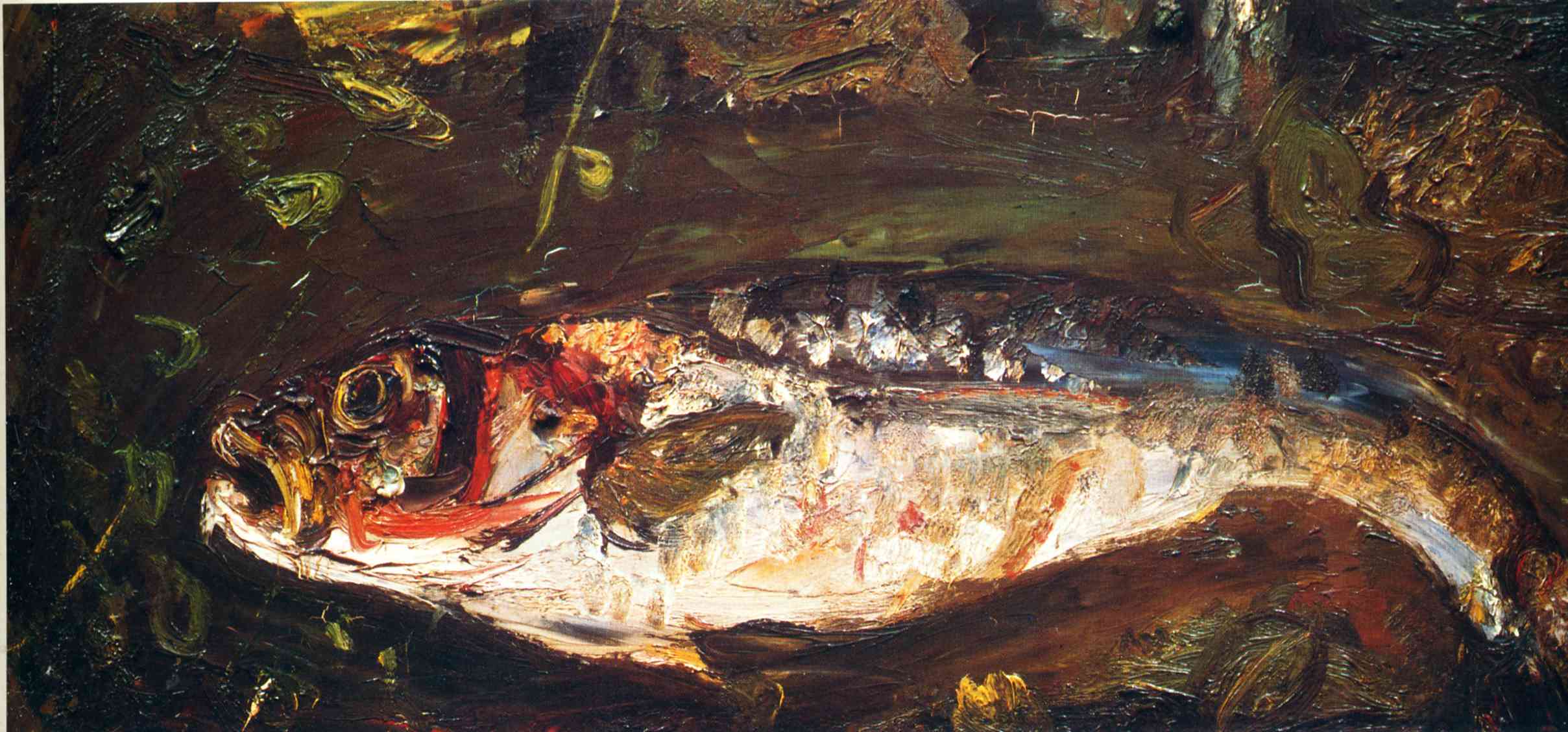
The Fish, c. 1933 Oil on console Private European collector
In this detailed depiction of a live fish, Soutine strove for a heightened realism. To achieve this effect, the artist turned for inspiration to his predecessor Gustave Courbet, whose 1872 painting of a trout has a similar composition. Soutine elaborated on Courbet's motif, endowing his own version with a feeling of anguish and passion.
| |
| Chaim Soutine, Plucked Goose, c. 1933, oil on console. Private Collection Artwork © Artists Rights Society (ARS), New York Photograph by Joshua Nefsky |
The broken neck and naked flesh of this goose are presented with precision and sensitivity, in an image at in one case savage and sublime. At that place is an intriguing echo of earlier depictions by the artist:
in Fish, Peppers, Onions the bird is present as a macabre crockery ornament. Through the naturalism of the 1930s, the artist conveys sentiments of vulnerability and pathos.
The Duck Pond at Champigny, 1943 Oil on canvas Shmuel Tatz Collection
In this late painting of the rustic outdoors, the rich blue greens of the woods and pond advise a yearning for immersion in nature. Its mode evokes the tradition of painting landscape outdoors, while its spirited brushwork and sensuality of surface anticipate brainchild. According to an inscription past Marie -Berthe Aurenche, Soutine's concluding companion, the work was painted in July, the month prior to the artist's death.

Turkey, c. 1925 Oil on sheet Musée de l'Orangerie, Paris, Collection of Jean Walter and PaulGuillaume
pritchardobace1952.blogspot.com
Source: http://arthistorynewsreport.blogspot.com/2018/05/chaim-soutine-flesh.html
0 Response to "Soutine Chaim Carcass of Beef Print Ebay"
إرسال تعليق